
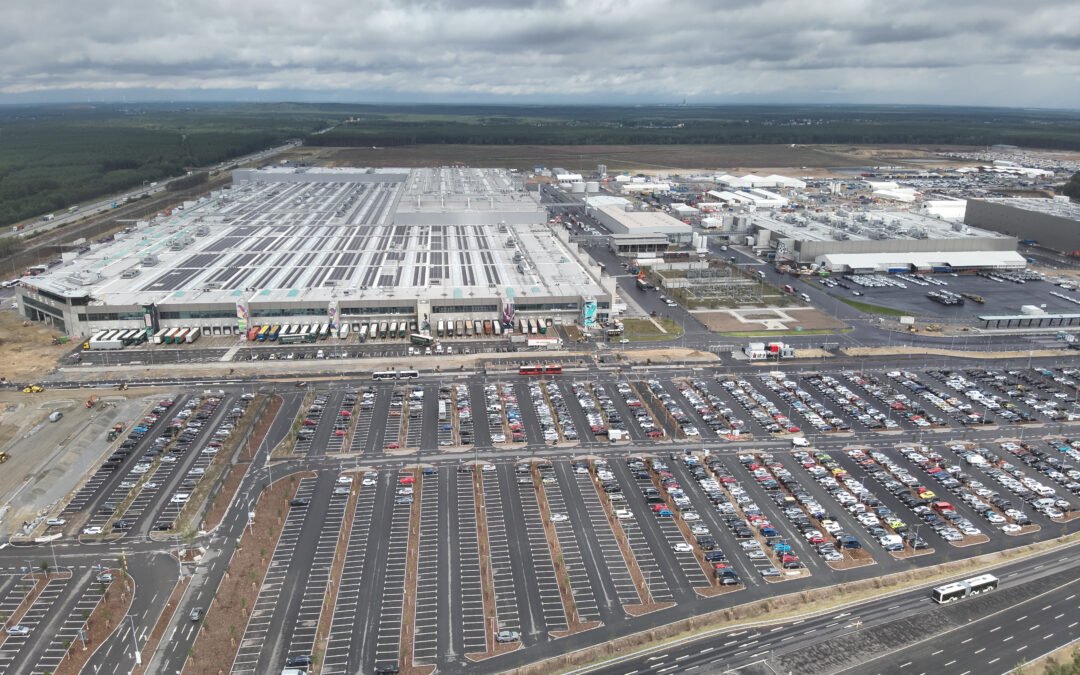
Tesla’s European story has taken a sharper turn: after a bruising stretch of slower registrations and tougher competition, the company is preparing to add another 1,000 workers at its Giga Berlin plant and lift output to a reported 7,500 vehicles a week by October. For EV buyers and industry watchers, that is more than a staffing update. It is a sign that Tesla wants to defend one of its most important regional beachheads just as BYD and other Chinese brands push harder into Europe and Australia.
Tesla pushes Giga Berlin toward a higher gear
Electrek reports that Tesla has confirmed plans to hire 1,000 additional staff at its Grünheide factory near Berlin. The target is ambitious: around 7,500 cars a week from October, following an earlier hiring round intended to lift production to roughly 6,000 vehicles a week. If sustained, that pace would put the site near 390,000 vehicles a year, still below the 500,000-a-year ambition Tesla talked up when the plant opened, but comfortably above its recent rhythm.
The timing matters. Tesla’s European demand has been under pressure from model ageing, political noise around the brand, and a flood of new rivals. But the company appears to be betting that a refreshed Model Y, lower running costs compared with petrol cars, and stronger local output can rebuild momentum. Giga Berlin is also strategically useful because it gives Tesla a European manufacturing base at a time when trade rules, battery sourcing and regional incentives are becoming more important to EV economics.
BYD keeps the product pressure on
BYD is not waiting around. CnEVPost reports that the Chinese giant will officially launch the Seal 08 sedan on July 2 as a flagship for its Ocean line-up. The car is pitched as a mid-to-large sedan and is expected to feature BYD’s second-generation Blade Battery, rear-wheel steering, DiSus-A body control and the company’s latest flash-charging technology, which BYD says can take the battery from 10% to 97% in just nine minutes under suitable conditions.
That mix of battery claims, premium hardware and aggressive model cadence is exactly why Tesla’s factory ramp is so important. BYD is attacking on several fronts: passenger cars, plug-in hybrids, batteries and even home-energy systems. At the Smarter E Europe exhibition in Munich, BYD also broadened its European energy-storage range with a residential ecosystem that includes smart energy management, backup power and an AC Charging Box designed to integrate EV charging with home storage.
Australia shows how fast the market can move
The competitive picture is especially visible in Australia, where recent market data reported by The Driven showed EVs hitting a record 20% share of new-vehicle sales in May. Tesla and BYD remain central to that surge, but the gap between the leaders and emerging Chinese brands is narrowing as buyers get more choices across SUVs, sedans and plug-in hybrids. For consumers, that usually means sharper pricing, better equipment and more pressure on charging networks to keep up.
The takeaway for EV enthusiasts is simple: the next phase of the electric-car race is not just about who has the most famous badge. Tesla is trying to turn manufacturing scale back into a weapon in Europe, while BYD is using rapid product launches and battery integration to pull buyers into its ecosystem. If both strategies work, 2026 could bring better value, faster charging and a much busier showroom floor.