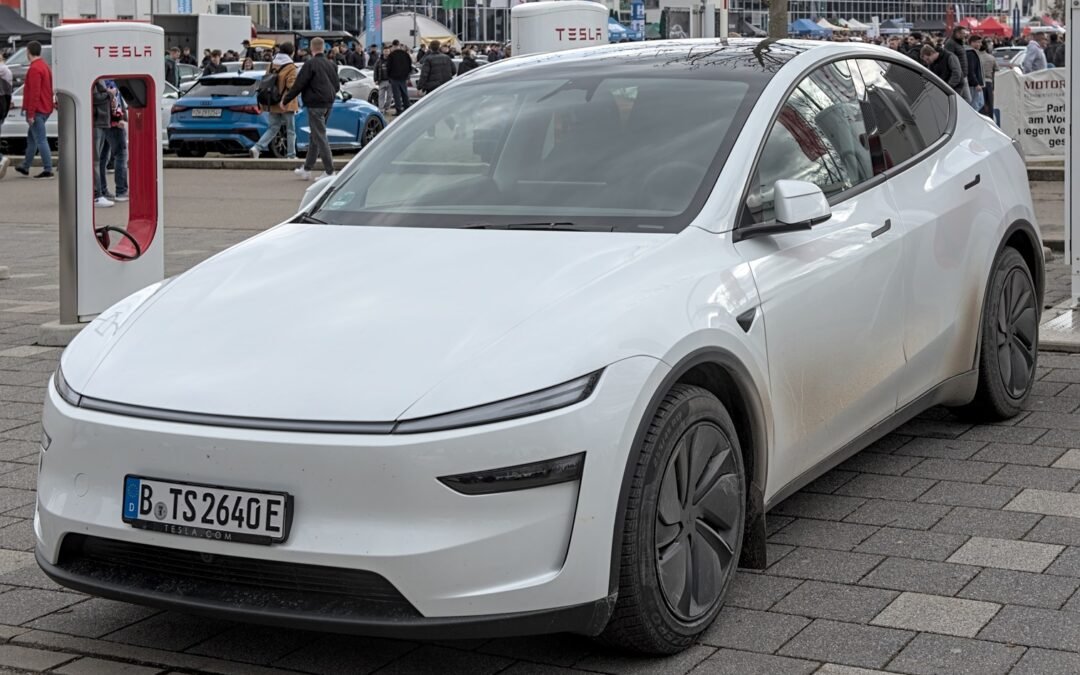
Australia’s electric-car market has just delivered one of its clearest signals yet: EVs are no longer a fringe choice, and Tesla and BYD are still the names setting the pace. Fresh industry coverage from The Driven says Australia’s record-breaking June produced an unusually crowded list of big-selling electric models, with the Tesla Model Y, Tesla Model 3 and BYD Sealion 7 among the vehicles now capable of posting four-figure monthly sales.
Tesla and BYD turn up the volume
The most interesting part of the latest Australian data is not simply that EV sales were strong. It is how quickly the market is maturing. Until recently, monthly sales above 1,000 units were mostly the preserve of Tesla’s Model Y and Model 3. The Driven’s July 10 report notes that BYD’s Sealion 7 has now joined that group, underlining how aggressively the Chinese brand is moving from value challenger to mainstream force.
That matters because Australia has traditionally lagged markets such as Europe and China on EV adoption, held back by limited model choice, higher prices and uneven charging confidence. A month in which Tesla and BYD together helped push electric cars to a landmark share of new-car sales suggests the demand curve is changing. Buyers are not just sampling EVs; they are increasingly choosing them in the heart of the family-car market, where SUVs and practical sedans dominate.
The global race is tightening
The Australian story fits a wider global pattern. Electrek reported on July 10 that more than 463,000 EVs were sold in the United States during the first half of 2026, with Tesla still commanding about 50.5 percent of that market. The Model Y remained America’s best-selling EV with 163,454 units, while the Model 3 held second place despite a year-on-year decline. Chevrolet, Hyundai, Cadillac and Toyota are all gaining ground, but Tesla’s lead in the US remains substantial.
Globally, however, BYD is applying pressure that Tesla cannot ignore. Recent reporting from InsideEVs said BYD delivered 557,090 fully electric cars in the second quarter of 2026, compared with Tesla’s 480,126 vehicles. Tesla’s result was still a major rebound and one of its strongest quarters, but BYD’s scale shows why the EV contest is increasingly being fought on price, battery supply, production speed and regional model line-ups rather than brand recognition alone.
More choice is reshaping EV buying
The supporting cast is also getting stronger. Electrek’s US list showed the Hyundai Ioniq 5 as the best-selling non-Tesla EV in the first half of the year, while Toyota’s bZ, Chevrolet’s Equinox EV, Rivian’s R1S and Ford’s Mustang Mach-E all remained in the mix. That broader spread is healthy for buyers: it means more body styles, more price points and more pressure on every manufacturer to improve range, charging speed, software and after-sales support.
For EV enthusiasts, the takeaway is simple: Tesla is still the benchmark in several markets, but BYD is no longer merely chasing. In Australia especially, the two brands are accelerating the shift from early adoption to everyday adoption. If June’s record month becomes the new baseline rather than a one-off spike, the next phase of the EV race will be less about whether Australians are ready for electric cars and more about which automakers can deliver the right EVs at the right price.