
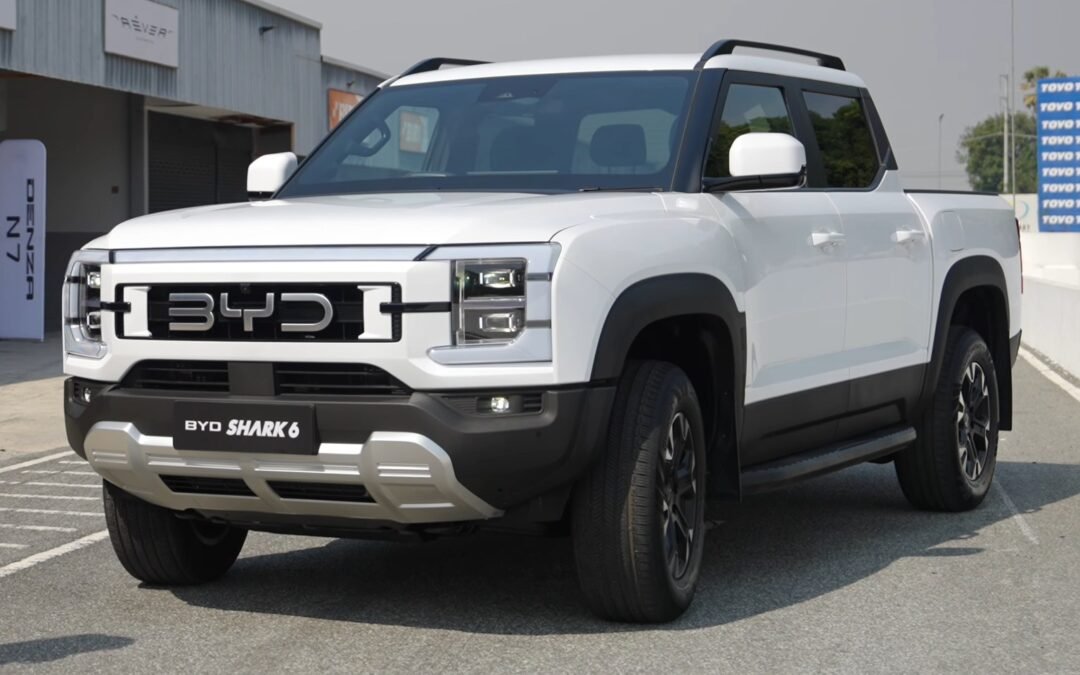
BYD has taken a fresh bite at Europe’s pickup market, opening UK orders for the Shark plug-in hybrid ute with a headline-grabbing electric range claim and a price that puts it squarely in Ford Ranger territory. The move matters because pickups have been one of the hardest vehicle segments to electrify at scale, and BYD is using its fast-growing global footprint to test whether workhorse buyers are ready for a battery-assisted alternative.
BYD brings the Shark to Britain
According to Electrek, the BYD Shark is now available to order in the UK from £47,290 including VAT, or roughly US$63,000, with customer deliveries expected before the end of the year. The Shark is already sold in markets including Australia, Mexico, Brazil, Chile and Peru, so Britain becomes another proving ground for BYD’s expanding export strategy. While it is not a pure battery-electric vehicle, its 32.2 kWh Blade Battery gives it a claimed 55.9 miles of electric-only driving, substantially more than the Ford Ranger PHEV’s 27-mile electric range.
The specification is aimed at buyers who still want towing, payload and long-distance flexibility. BYD quotes 430 hp from dual electric motors, all-wheel drive, a 0-100 km/h time of 5.7 seconds, a 2,500 kg towing capacity and up to 6.6 kW of vehicle-to-load power for tools, camping gear or job-site equipment. That mix of everyday electric running and petrol-backed range could make the Shark a useful bridge product for drivers who are not yet ready to commit to a fully electric pickup.
Tesla’s larger Model Y moves closer
Tesla is still central to the week’s EV story. The Driven reports that the first US-built Model Y L has rolled off Tesla’s Giga Texas production line, pointing to progress on the long-wheelbase, six-seat version of the company’s best-selling SUV. Search results from Tesla-focused outlets also indicate production is spooling up in Texas. If the Model Y L reaches customers in volume, it gives Tesla a more practical family option at a time when BYD and other Chinese brands are widening their line-ups at speed.
The broader sales race remains fierce. InsideEVs reported this week that BYD reclaimed the global battery-electric sales crown in the second quarter with 557,090 BEV deliveries, even after Tesla posted a strong 480,126 deliveries for the same period. In Australia, The Driven reported earlier this month that Tesla and BYD both smashed local EV sales records in June, helping electric cars reach a 23.4 percent share in a landmark month. In short, the “EV slowdown” narrative looks very different in markets where price, supply and model choice are improving.
Competition is pushing faster change
Safety and affordability are also shaping the market. GM has halted shipments and issued recalls for nearly 15,000 Cadillac Vistiq electric SUVs over a power-folding third-row seat issue, a reminder that new EV platforms still face traditional quality and safety scrutiny. At the same time, premium brands are using incentives and charging offers to keep buyers interested as competition tightens and shoppers become more price-sensitive.
For EV enthusiasts, the takeaway is clear: electrification is spreading beyond compact hatchbacks and familiar SUVs into tougher, more specialised segments. BYD’s Shark may be a plug-in hybrid rather than a full EV, but its electric-first daily driving pitch shows where the pickup market is heading. With Tesla preparing a roomier Model Y and BYD pushing aggressively into new regions, the next phase of the EV race will be fought on practicality as much as range.