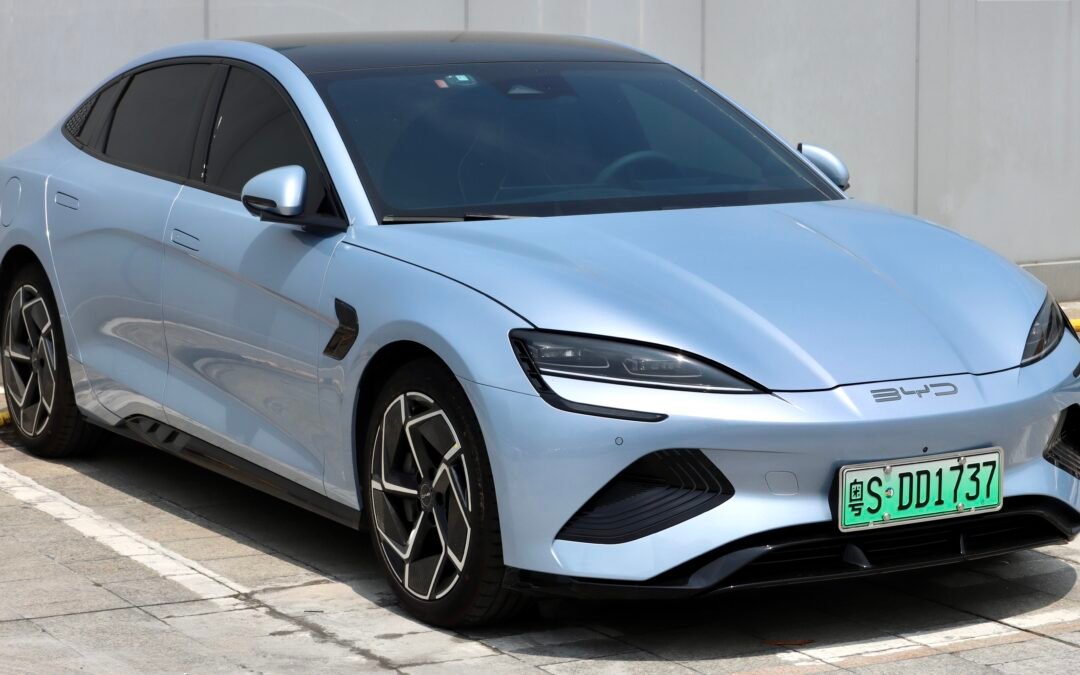
BYD is using its popular Seal sedan to sharpen the next phase of the EV battle: smarter, cheaper driver-assistance technology. A fresh report out of China says BYD Chairman Wang Chuanfu has evaluated upcoming driving-assistance software in a Seal alongside Horizon Robotics chief executive Yu Kai, putting the mass-market electric sedan at the centre of a broader push to reduce reliance on Nvidia-powered systems.
The timing matters. EV makers are no longer competing only on range, charging speed and sticker price. Increasingly, the dashboard computer, cameras and software stack are becoming just as important as the battery pack. BYD’s latest testing points to a strategy built around localised processing, lower component costs and fast deployment across high-volume models rather than reserving advanced assistance tech for only expensive flagships.
BYD’s smart-driving cost play
According to CarNewsChina, the Seal test involved Horizon Super Drive 2.0, with engineers working to connect camera inputs more directly to central domain-controller modules. BYD has also developed its own Xuanji A3 four-nanometre chip platform, rated at 700 TOPS, but that internal hardware is not expected to reach production until 2027, initially on premium Denza models. That leaves a near-term opening for suppliers such as Horizon Robotics to power BYD’s volume cars.
The commercial incentive is obvious. External cabin-driving convergence processors can reportedly save between 1,500 yuan and 4,000 yuan per vehicle, roughly US$221 to US$588. In a market where Chinese EV brands are fighting intense price pressure, even a few hundred dollars per car can protect margins or fund better equipment. The wider industry data also shows why this matters: Nvidia still led China’s passenger vehicle domain-controller market in April with a 50.9 percent share, while Horizon Robotics reached 13.6 percent. BYD’s scale could quickly change that balance.
Tesla answers on software, but questions remain
Tesla had its own software headline, with Electrek reporting that FSD v14 “Lite” has started rolling out to vehicles equipped with older HW3 hardware. That is welcome news for owners who have waited for an update, but the system remains supervised Level 2 driver assistance rather than the unsupervised self-driving capability many buyers expected. The rollout highlights a key contrast: Tesla is leaning on fleet data and software iteration, while BYD is pushing cost-efficient hardware localisation across huge production volumes.
Another Tesla story underlined the operational side of scaling EVs. Electrek reported sheriff’s records showing trailers loaded with Tesla Powerwalls and vehicle batteries were stolen from the company’s Nevada operations at least 11 times since December. Battery logistics are now big business, and the incident is a reminder that energy storage supply chains are becoming as valuable, and as vulnerable, as the vehicles themselves.
More electrified models keep coming
BYD also launched the Linghui M9 plug-in hybrid MPV for China’s ride-hailing market, priced from 188,800 yuan, or about US$27,770. The seven-seat people mover pairs a 1.5-litre turbo petrol engine with a 200 kW electric motor and a 26.6 kWh LFP battery for up to 118 km of electric driving and a claimed combined range of 1,105 km. It is not a pure EV, but it shows how BYD is using electrified platforms to target commercial fleets as well as private buyers.
For EV enthusiasts, the takeaway is clear: the next race is not just Tesla versus BYD on sales charts. It is software versus hardware, global platforms versus local supply chains, and premium promises versus affordable scale. If BYD can bring smarter driving tech to mainstream EVs without inflating prices, Tesla and every other electric carmaker will have to respond quickly.