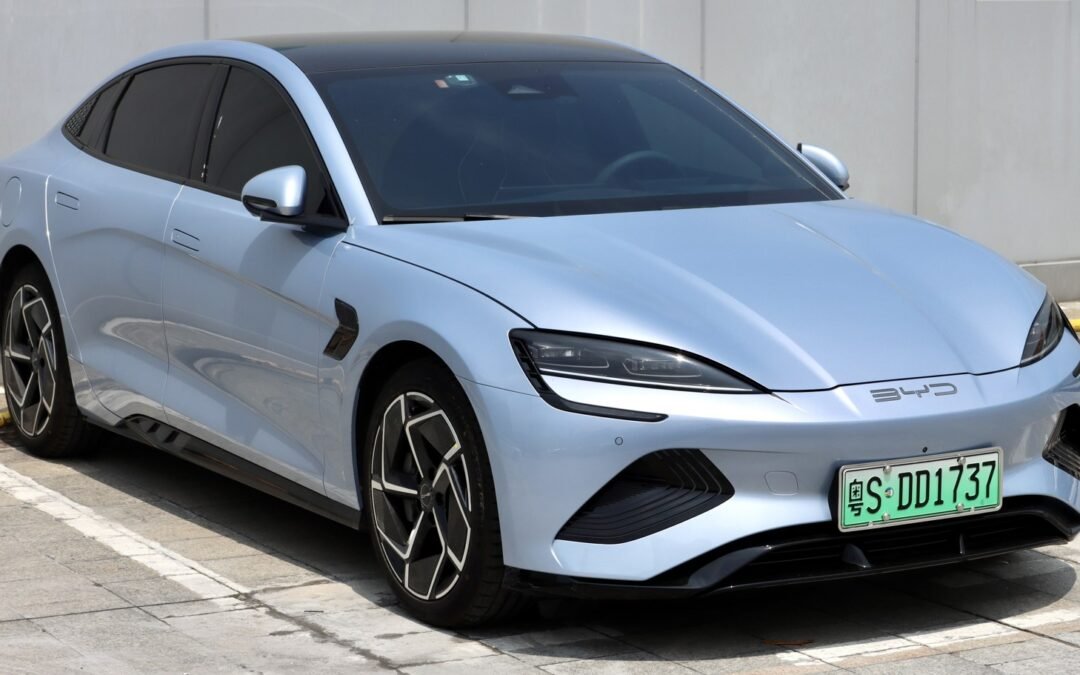
BYD has delivered the week’s sharpest reminder that the electric-car race is no longer just about who can build the most cars — it is about who can make advanced EV hardware feel affordable. The Chinese giant’s new Seal 08 flagship sedan reportedly drew about 65,000 locked-in orders in a little over 30 hours after launch, giving Tesla another high-profile rival in the fast-moving electric sedan and family-car market.
BYD’s flagship sedan lands with serious momentum
The Seal 08 is being pitched as a technology-heavy flagship rather than a stripped-down budget EV, yet its starting price in China has been reported at 196,900 yuan, or roughly US$28,980. That combination is what makes the story stand out. Reports from CarNewsChina and Electrek describe a long, premium sedan with both pure-electric and plug-in hybrid options, rapid charging capability and high-output dual-motor versions said to reach up to 694 horsepower. For buyers, it sounds like luxury-car performance at a mainstream price; for rival automakers, it is a margin problem with wheels.
The order rush matters because BYD is already back in front of Tesla on global battery-electric volume. Electrek reported that BYD delivered 557,090 fully electric vehicles in the second quarter of 2026, while Tesla’s own Q2 figure came in at 480,126 deliveries. Tesla’s result was still a strong rebound — up 25% year over year and comfortably above expectations — but the gap shows how quickly BYD has scaled from domestic powerhouse to global benchmark.
Tesla answers with volume and a bigger Model Y
Tesla is not standing still. Its second-quarter delivery beat suggests demand remains resilient despite fierce pricing pressure, model-age concerns and intensifying competition in China and Europe. The company has also widened its U.S. SUV line-up with the Model Y L, a stretched, three-row, six-seat version listed by multiple outlets at US$61,990 in Launch Series form. With an estimated 325 miles of range, it gives Tesla a roomier answer for families who wanted more practicality than the regular Model Y without jumping to a much larger vehicle.
The contrast between the two strategies is becoming clearer. Tesla is leaning on brand strength, software, charging access and carefully targeted variants, while BYD is pushing a relentless product cadence across sedans, SUVs, plug-in hybrids and full EVs. The Seal 08’s early order book suggests Chinese consumers are responding to that speed, especially when high-end specifications arrive at prices that undercut many Western-market EVs.
The wider EV market keeps heating up
Other signals point to a market that is still expanding, not fading. UK battery-electric registrations reportedly jumped 38% in June to 64,440 units, reaching nearly 30% market share, with Tesla rebounding and BYD also gaining ground. Meanwhile, charging, battery chemistry and export policy remain decisive battlegrounds. BYD’s Blade battery reputation, Tesla’s Supercharger ecosystem and the rapid rise of Chinese supply chains are all shaping what buyers will expect from their next car.
For EV enthusiasts, the takeaway is simple: competition is doing its job. A sedan like the BYD Seal 08 puts pressure on pricing and equipment levels, while Tesla’s delivery rebound proves the established EV leader still has enormous pull. The next phase of the electric transition may be less about whether EVs can go mainstream and more about how quickly legacy brands can keep up with the pace being set by Tesla and BYD.