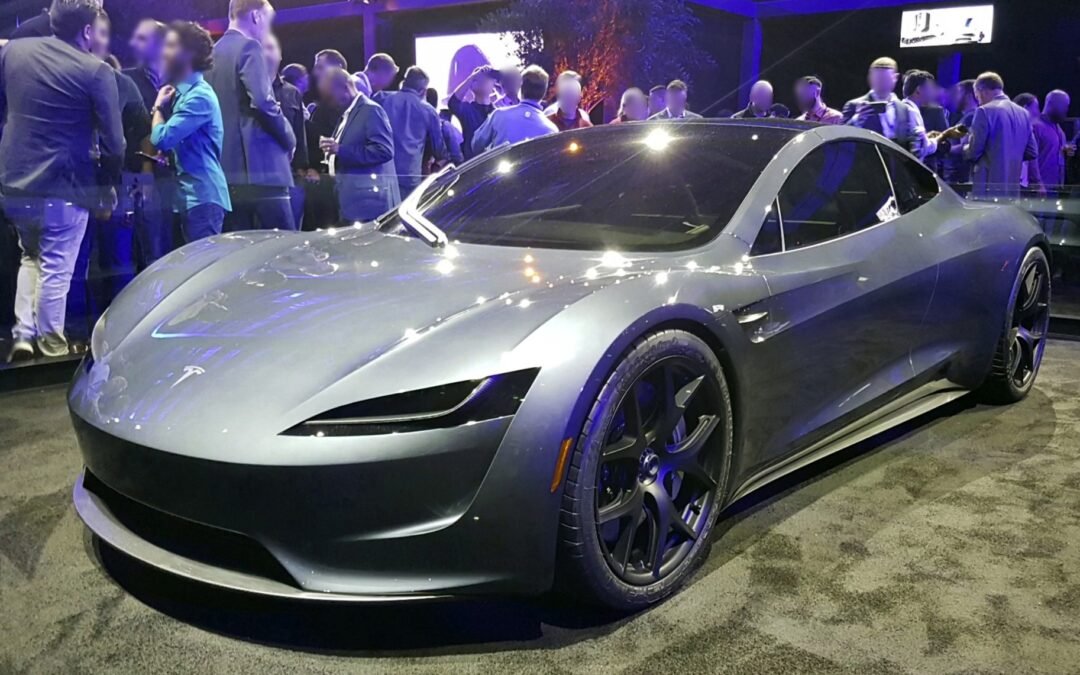
Tesla has switched the order book for its long-delayed next-generation Roadster back on, giving the electric halo car fresh momentum less than two weeks before a planned October 1 reveal. The move is more than a website update: after years of shifting timelines, Tesla is once again asking customers to put real money behind its most ambitious passenger car. It also gives the EV maker a high-performance headline at a time when Chinese rivals are widening the competition from family cars to commercial vehicles and charging infrastructure.
Roadster reservations return
Tesla’s official reservation page is live again in multiple markets. In the United States, reports say a place in the queue requires an initial US$5,000 card payment followed by a US$45,000 bank transfer within 10 days, making the total refundable reservation payment US$50,000. Australian customers are being quoted a A$66,000 reservation payment, although final local pricing and delivery timing remain unclear. Those are substantial sums for a vehicle whose production specification has not yet been fully disclosed, so the October presentation needs to supply credible answers on price, performance and manufacturing.
The Roadster story carries unusual baggage. Tesla first showed the second-generation concept in 2017, pitching supercar acceleration, four seats and exceptional range, but the programme repeatedly moved down the priority list while the company expanded mass-market production and invested in autonomy, robotics and the Cybercab. Tesla’s recent “Go for launch” teaser points to an October 1 event, but enthusiasts should distinguish a reveal from customer deliveries. The key test will be whether Tesla presents a production-intent car and a firm path to manufacturing, rather than another spectacular prototype and a distant promise.
Tesla improves the ownership experience
Two smaller Tesla updates released alongside the Roadster news may affect many more drivers. The latest Tesla mobile app adds detailed Supercharger site maps, allowing users to inspect station layouts and live charger availability from their phones before arrival. That can remove a surprisingly common pain point at unfamiliar or complicated charging sites. App version 4.61.0 is also rolling out passkey support, enabling secure sign-in through device-based cryptographic credentials and biometrics such as Face ID or Touch ID instead of relying only on a conventional password. Together, the changes show how software can improve everyday EV usability without changing a car’s hardware.
BYD and CATL target electric freight
Beyond passenger cars, the race to electrify heavy transport is intensifying. BYD’s new ETT 44 tractor for Europe pairs a 651 kWh lithium-iron-phosphate Blade Battery with a claimed range of nearly 600 kilometres. It supports charging at up to 1.5 MW, with BYD claiming a 20-to-80 per cent recharge in about 20 minutes under suitable conditions. Battery giant CATL is applying similar thinking with its modular TECTRANS II commercial-vehicle platform, which promises up to 1,000 kilometres in its largest configuration and an 80 per cent charge in 25 minutes using megawatt charging. CATL has also signed an agreement with DHL to explore green freight corridors in Europe.
The Roadster will command attention because speed and drama sell dreams, but this week’s wider developments show where EV progress is becoming practical. Better charging information, stronger account security and faster-turnaround electric trucks can all reduce friction for drivers and fleet operators. October 1 should reveal whether Tesla’s sports car is finally ready to move from promise to production; meanwhile, the less glamorous work of making electric transport easier and more productive is already accelerating.