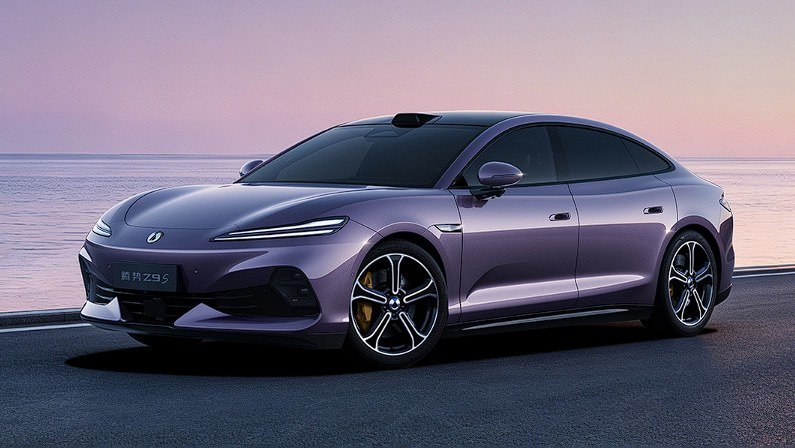
BYD has turned up the pressure on Tesla and China’s crowded premium-EV field with the launch of the Denza Z9S, a large electric sedan claiming as much as 1,100km of range on China’s CLTC test cycle. The headline number needs the usual test-cycle caveat, but the combination of long range, enormous performance and unexpectedly aggressive pricing makes this more than another specification-sheet special.
A premium EV at Model 3 money
According to CarNewsChina’s launch report, the Denza Z9S is offered in China from 255,800 to 325,800 yuan, or roughly US$37,600 to US$47,900. That puts it close to the locally built Tesla Model 3 despite the Denza’s more overtly luxurious positioning and substantial 5.09-metre length. Buyers can choose a 370kW rear-drive model or an 890kW tri-motor flagship, the latter capable of a claimed 0-100km/h sprint in 2.68 seconds. Its equipment list includes a 17.3-inch centre display, a 50-inch head-up display, rear-wheel steering, air suspension and BYD’s latest driver-assistance package.
The biggest talking point is BYD’s second-generation Blade Battery. Depending on variant, the Z9S uses a 102.326kWh or 122.496kWh pack and carries CLTC ratings of 780km, 920km or 1,100km. The generous Chinese cycle is not directly comparable with Australia’s WLTP-based figures, so shoppers should not expect 1,100 real-world kilometres. Even so, the long-range version’s combination of a large lithium-iron-phosphate battery and flash-charging capability illustrates how quickly BYD is moving range anxiety from a technical problem to a marketing contest.
BYD’s range push is spreading
The Z9S was not BYD’s only range story in the past day. A new Chinese regulatory filing, detailed by CarNewsChina, lists the next Seal 07 with an 88.682kWh battery, a 300kW motor and 875km of CLTC range—estimated at about 718km under WLTP. An entry version is listed with a 76.744kWh pack, 245kW and roughly 636km WLTP. The report says the smaller battery can charge from 10 to 97 per cent in nine minutes. These are China-market specifications, and neither an Australian launch nor local figures have been confirmed, but they show BYD attacking range, charging speed and price simultaneously.
Australia’s EV price fight gets busier
Australian buyers are also getting another aggressively priced alternative. EV Central reports that XPeng has opened local pre-orders for the L03 from $41,900 before on-road costs. That price applies to both the entry rear-drive battery-electric model and the PowerX range-extender, while a long-range EV costs $46,900 and an all-wheel-drive Performance Ultra is $53,900. Final Australian battery, range and charging specifications remain pending, but XPeng’s pricing lands squarely in territory where BYD, Tesla and other Chinese brands are already competing hard.
Charging technology is becoming just as important as sticker price. Reuters reported in the past 24 hours that Geely is pitching four-minute EV charging and AI-driven battery management as it challenges BYD. Taken together, the Denza Z9S, the new Seal 07 data and XPeng’s Australian expansion point to the same takeaway: EV leadership is no longer about one breakthrough. The winners will need competitive range, genuinely fast charging, polished software and prices that make the technology accessible.