
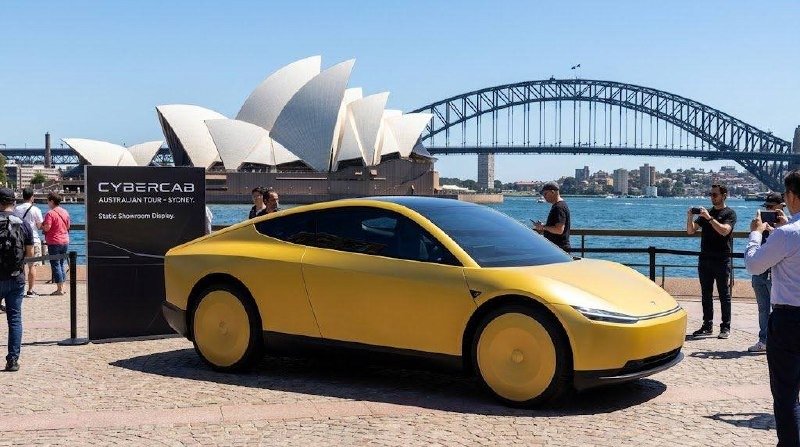
Tesla’s Cybercab has arrived in Sydney today, bringing one of the world’s most radical autonomous-vehicle concepts directly into an Australian showroom. With no steering wheel, no accelerator and no brake pedal, the two-seat electric vehicle is designed around the idea that software—not a human driver—will handle every journey.
For now, Australians will only be able to inspect it as a static display. Tesla has described the local visit as a technology showcase rather than a commercial launch, and there is no suggestion that the Cybercab will be carrying passengers on Australian public roads during the tour. Even so, its arrival makes an abstract policy debate feel suddenly real.
A car designed without a human fallback
The Cybercab’s cabin removes the conventional controls that define almost every passenger vehicle currently approved for Australian roads. Tesla has built its wider autonomy strategy around camera-based perception and neural-network software, rather than the lidar-heavy approach used by several robotaxi competitors. The company’s ambition is a purpose-built autonomous taxi that can operate without an onboard driver.
That design creates an immediate regulatory challenge. Australian Design Rules have traditionally assumed that a vehicle will contain controls for a licensed human driver. A production model with no steering wheel or pedals would therefore need to satisfy, or receive exemptions from, requirements written for a fundamentally different type of machine.
Australia’s framework is still being built
The National Transport Commission says Australia is developing an end-to-end framework for the safe commercial deployment of automated vehicles. Transport ministers agreed in November 2025 to work towards conditional deployment in selected locations from 2027, subject to states and territories updating their laws and building the capabilities needed to oversee the technology.
At present, Australian road laws cover advanced driver-assistance systems on the basis that a human remains responsible and in control. That is very different from SAE Level 4 or Level 5 automation, where the automated driving system performs the driving task without continuous human supervision. Questions about legal responsibility, insurance, incident investigation, remote assistance, cybersecurity, data access and minimum safety performance all need nationally consistent answers before robotaxis can operate at scale.
The hardware has arrived before the rulebook
The Sydney display is therefore more than a futuristic photo opportunity. It shows how quickly vehicle design is moving beyond the assumptions built into today’s standards. Australia must decide not only whether a driverless vehicle is mechanically roadworthy, but how its automated driving system will be certified, monitored and held accountable throughout its operating life.
A cautious rollout is sensible; public confidence will depend on transparent safety evidence and clear responsibility when something goes wrong. But fragmented state rules or prolonged uncertainty could also leave Australia watching autonomous transport develop elsewhere while local operators, emergency services, insurers and road agencies struggle to prepare.
The Cybercab will not drive itself out of the Sydney showroom today. Its presence nevertheless delivers a blunt message: the technology is no longer theoretical, and the legislative timetable now matters as much as the engineering.
Sources: CarExpert’s Australian Cybercab tour report and the National Transport Commission automated vehicle program.