
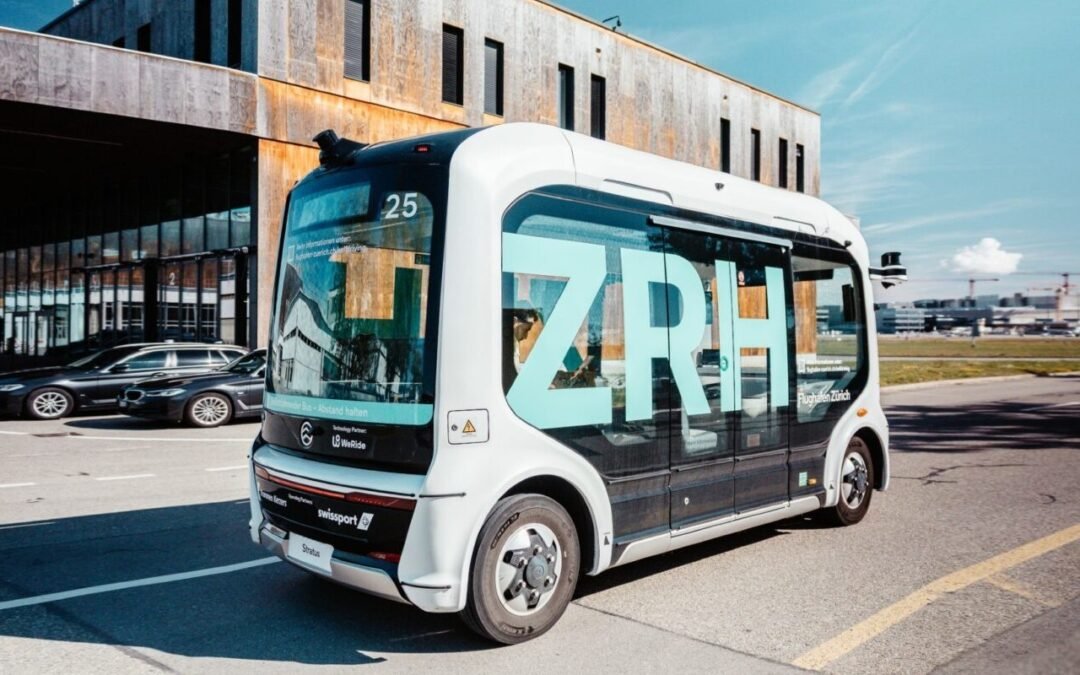
Electric mobility is moving beyond the public road and into one of transport’s most demanding workplaces. Zürich Airport has begun operating two fully automated electric shuttle buses without an onboard safety monitor, putting Level 4 autonomy to work in a tightly controlled but genuinely live environment. It is a modest fleet with an outsized message: the next useful step for self-driving EVs may be a staff route behind the security fence rather than a headline-grabbing robotaxi in a city centre.
Level 4 autonomy enters daily airport operations
The two shuttles were co-developed with Chinese autonomous-vehicle specialist WeRide and have been tested through a phased program dating back to March 2025, according to Electrek’s report. They now run on a defined airport route that avoids aircraft taxiways and runways. Although there is no safety driver or monitor aboard, remote supervision remains available so a human operator can intervene if required. The initial Level 4 journeys will run without passengers; airport employees are expected to begin using the service after about four weeks of test operation.
That careful rollout matters. Airports offer repeatable routes, controlled access and a strong operational case for automation, but they also leave little tolerance for error. Zürich says safety remains its priority, while also pointing to a shortage of skilled workers as a reason to prepare for automated vehicles. The project involves employees from ground-services company Swissport and logistics specialist Krummen Kerzers, with each partner supplying remote operations monitoring. The battery-electric format adds a second benefit by helping the airport reduce emissions from routine ground transport, where vehicles often travel short distances and return frequently to a base.
Tesla spectacle and BYD scale stay in focus
The weekend also delivered reminders of the EV industry’s two dominant storylines: high-performance ambition and industrial scale. Tesla has confirmed an October 1 reveal for its long-delayed next-generation Roadster, using a “Go for launch” teaser to revive attention nearly nine years after the prototype first appeared. The reveal should finally show how closely the production plan matches Tesla’s extraordinary original promises. BYD, meanwhile, is thinking in cargo-ship quantities. Industry reports say the company has ordered ten more 9,200-car pure car and truck carriers, although BYD had not publicly confirmed that order in the cited coverage. If completed, the expansion would underline how seriously the Chinese group is building its own export infrastructure rather than relying entirely on outside shipping capacity.
Solar charging reaches the farm
Electrification is spreading off-road as well. Ohio-based GoSun and Indian manufacturer Moonrider have introduced a compact electric tractor built around a 20 kW motor, four-wheel drive and a 24 kWh lithium-iron-phosphate battery. The companies claim up to five hours of operation, while a conventional 220/240-volt connection handles plug-in charging. Its unusual option is a 1.1 kW folding solar array that can reportedly add roughly 1.5 hours of runtime during a sunny day. A standard 540 rpm rear power take-off is intended to preserve compatibility with familiar equipment such as mowers, tillers and post-hole diggers—an important practical detail for buyers who cannot replace an entire implement collection.
For EV enthusiasts, the bigger takeaway is that electric transport is diversifying quickly. A driverless airport shuttle, a solar-assisted tractor, a global shipping fleet and an electric supercar may look unrelated, yet each tackles a different obstacle: labour, energy access, distribution or desirability. Zürich’s cautious deployment is the least theatrical of the week’s developments, but it may be the most instructive. Real progress often begins where the route is predictable, the duty cycle is known and the technology can prove its value one shift at a time.