
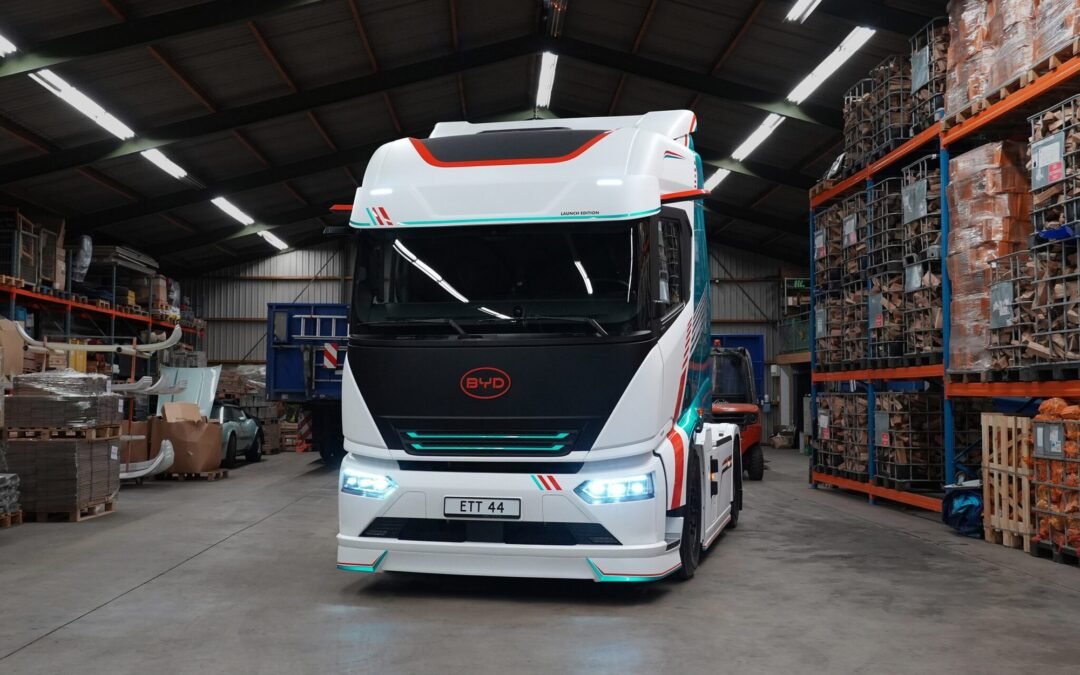
BYD has put Europe’s heavy-truck establishment on notice with the ETT 44, a battery-electric tractor promising up to 600 kilometres of range and charging power of up to 1.5 megawatts. Unveiled for Europe at IAA Transportation 2026 in Hanover, the new flagship moves BYD’s fast-charging ambitions beyond passenger cars and into one of transport’s hardest sectors to decarbonise.
A serious long-haul specification
The 4×2 ETT 44 is designed for combinations weighing up to 44 tonnes and will be offered with 651kWh and 434kWh battery packs. BYD quotes respective ranges of 600km and 400km under test conditions at a 40-tonne gross weight and 70km/h. Its integrated battery-and-chassis layout helps keep kerb weight to 11.12 tonnes, which the company says can free roughly 500kg of payload compared with competing trucks. The larger story, however, is charging: BYD says its Flash Charging system can take the battery from 20 to 80 per cent in about 20 minutes, adding approximately 300 to 400km of range. Conventional CCS2 charging at up to 425kW is also supported.
Europe’s electric-truck race tightens
BYD is not entering an empty lane. MAN used the same Hanover show to highlight its next-generation eTGX, with the 4×2 tractor offering up to 660km of range and a future seven-pack 6×2 version reaching 720km. MAN says Megawatt Charging System hardware can lift the battery from 20 to 80 per cent in around 30 minutes, deliberately matching a driver’s mandatory rest break. Those figures show where the commercial-vehicle contest is heading: usable range matters, but charging speed, payload, depot integration and uptime may matter even more. Tesla’s Semi also hangs over this contest, although no Tesla announcement from the past day matched the freshness and detail of BYD’s European launch.
Electric vans are joining the push
The transition is accelerating below the heavy-truck class as well. Kia’s newly revealed PV7 electric van has been confirmed for Australia in late 2027, with passenger and cargo forms, seating for up to nine, an 800-volt electrical system and DC charging at up to 350kW. Kia is targeting more than 460km of WLTP range for the long-range cargo model, subject to final homologation. That combination could give Australian fleets another practical option for shuttle, delivery and service work while bringing high-voltage charging technology into a segment long dominated by diesel.
Infrastructure remains the test
Fast vehicles still need chargers in the right places. In New York, the city has selected Brooklyn-based it’s electric to supply nearly 700 Level 2 curbside charging points across all five boroughs over three years, replacing pilot equipment and adding 600 plugs to 88 existing points. That project serves urban drivers rather than megawatt trucks, but it illustrates the same challenge: electrification succeeds when charging fits established routines. For freight operators, that means dependable depot power and corridor-based megawatt sites; for apartment residents, it means convenient overnight curbside access.
For EV enthusiasts, the ETT 44 is a sign that headline charging figures are rapidly moving from prototypes into fleet-ready products. BYD must still prove European service coverage, real-world efficiency and charger availability, but competition with MAN, Tesla and established truck brands should speed development. The next phase of the EV race will be measured not only by cars sold, but by how quickly vans and 44-tonne trucks can replace diesel kilometres.