
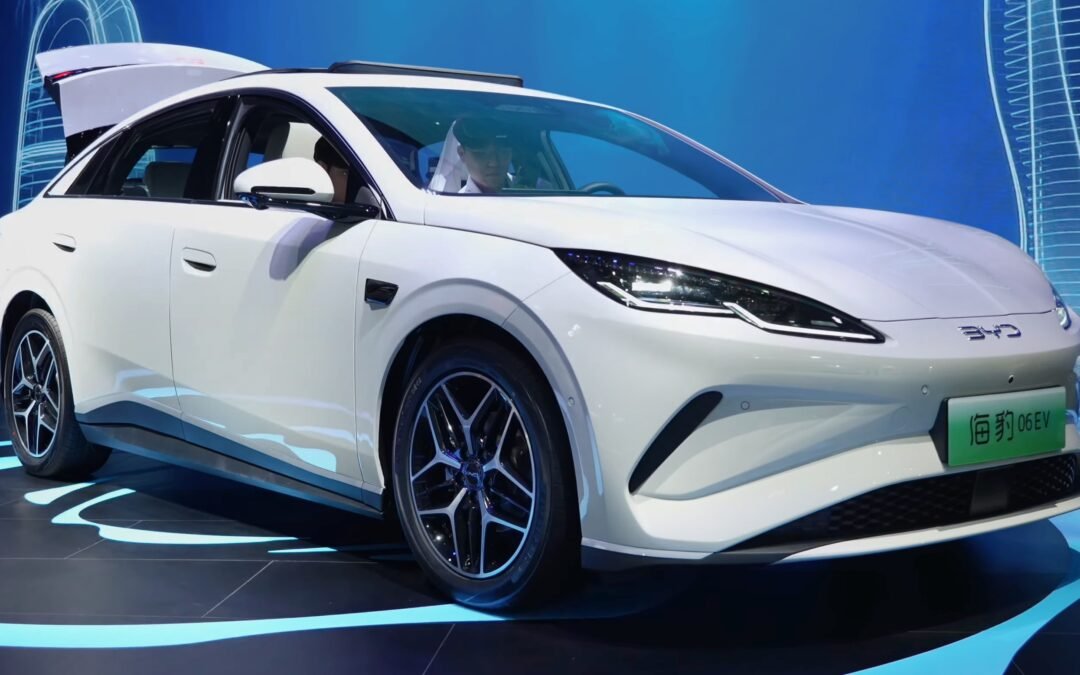
BYD may be heading into one of the world’s most consequential political rooms. Chinese officials are considering including the electric-vehicle giant in a business delegation accompanying President Xi Jinping to a planned summit with US President Donald Trump in Washington next week, Bloomberg reported on September 16. The invitation is not yet confirmed, but even the possibility highlights how electric cars have moved from an automotive story to the centre of trade and industrial policy.
BYD’s potential seat at the table
BYD’s presence would be significant because Chinese-built EVs remain effectively shut out of the US mass market by steep trade barriers. The United States applies a 100% tariff to EVs imported from China, on top of other duties, while security scrutiny of Chinese technology and supply chains has intensified. A summit appearance would not guarantee any tariff relief, and there is no indication that BYD is preparing an immediate US passenger-car launch. It would, however, give China’s largest new-energy vehicle manufacturer a visible role in discussions where manufacturing, subsidies, batteries and market access could all matter.
The timing reflects BYD’s increasingly global profile. Reuters reported earlier this month that the company’s sales growth streak continued on strong exports. BYD has been expanding across Europe, Latin America and the Asia-Pacific region while adding local production and dedicated vehicle-shipping capacity. That strategy reduces its dependence on China’s intensely competitive domestic market and makes trade policy in major overseas markets more important. For buyers, greater scale can mean more model choice and sharper pricing; for established carmakers, it raises pressure to accelerate affordable EV development.
Tesla pushes autonomy while rivals expand
Tesla, meanwhile, is trying to change the basis of EV competition. The company began public Cybercab rides in limited parts of Austin this month after unveiling the production vehicle on September 3. Reuters reported that the rollout is testing regulatory boundaries as Tesla builds its case for autonomous transport. The service remains geographically restricted, so its near-term effect on ordinary EV shoppers is limited. Still, Cybercab shows Tesla betting that software, ride services and vehicle autonomy can become as important as conventional retail sales.
Manufacturing is spreading at the same time. BMW has started producing the electric i7 in India, according to EV Infrastructure News, with the locally built luxury sedan supporting DC fast charging at up to 250kW. Local assembly of premium EVs will not solve affordability on its own, but it demonstrates how electric-car production is becoming less concentrated. Regional factories can shorten supply chains, reduce exposure to import duties and help brands tailor vehicles and service networks to local customers.
Why this matters for EV buyers
The next phase of the EV race will not be decided by range figures alone. BYD’s possible diplomatic role, Tesla’s robotaxi push and BMW’s expansion of regional manufacturing all point to a market shaped equally by policy, software and industrial scale. EV enthusiasts should watch next week’s Washington summit for any language on tariffs or market access—but also keep expectations realistic. A political meeting can change the direction of negotiations; turning that into cheaper cars and broader consumer choice usually takes much longer.