
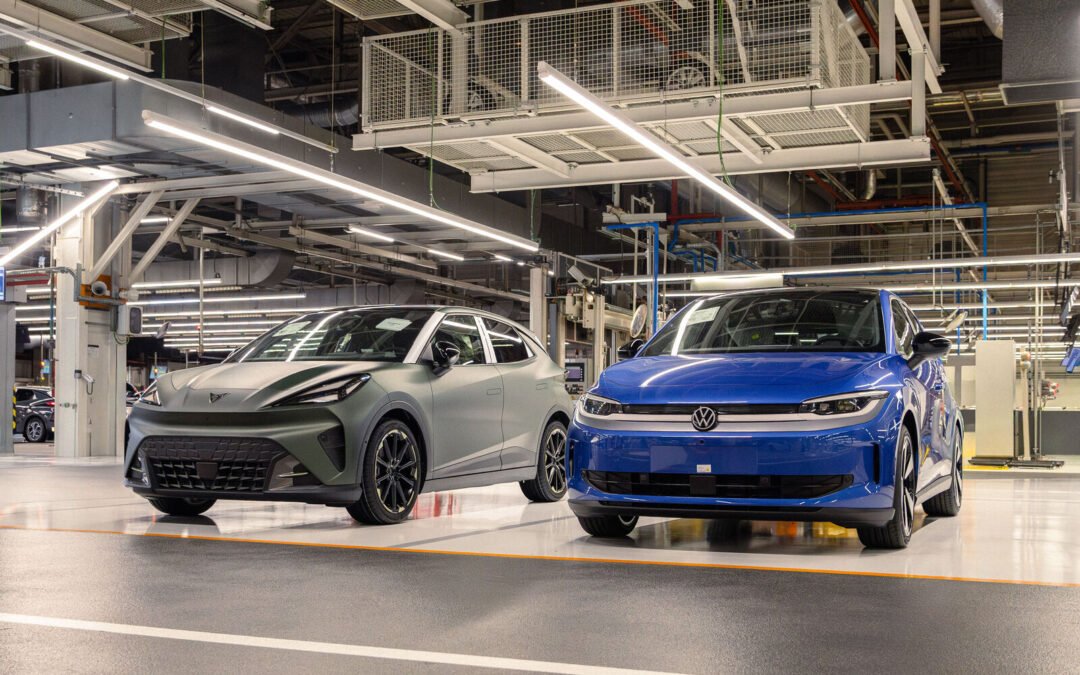
Europe’s next big electric-car story may not be a six-figure flagship or another record-setting super-sedan. It is the return of the small, relatively attainable hatchback. Volkswagen Group has started production of the Volkswagen ID. Polo and Cupra Raval at SEAT and Cupra’s Martorell plant in Spain, a move that puts one of the world’s largest automakers back into the affordability fight just as buyers are demanding lower prices and more practical EV choices.
Small EVs move from promise to production
The Martorell launch matters because it turns Volkswagen’s long-discussed Electric Urban Car Family from a motor-show talking point into factory reality. Volkswagen Newsroom says the Spanish plant is beginning production of the Cupra Raval and Volkswagen ID. Polo, with the project led by SEAT and Cupra. Electrive and Electrek also highlighted the start as a key step in VW Group’s push to build more affordable EVs for Europe, where compact cars still define daily transport for millions of drivers.
The ID. Polo name is significant on its own. Volkswagen is borrowing equity from one of its best-known small cars rather than asking mainstream shoppers to decode another anonymous alphanumeric badge. If VW can combine familiar branding, supermini dimensions and competitive pricing, the ID. Polo could become the kind of EV that expands the market rather than simply shifting existing premium buyers from one electric crossover to another.
Battery ambition keeps rising
The affordability race is happening alongside a technology race. ArenaEV reported that CATL is talking up lithium-air battery development with theoretical energy density comparable to gasoline and potential driving ranges far beyond today’s lithium-ion packs. That is not around the corner for ordinary showrooms, and it should be treated as a long-term research signal rather than a near-term buying guide. Still, it shows why battery suppliers are under pressure to deliver more than incremental gains: automakers want cheaper cells for entry models and breakthrough chemistry for the next generation of long-range EVs.
At the market’s other end, BYD’s premium momentum remains hard to ignore. Electrek reported that BYD’s 1,000-km-range luxury GT is off to a hot start, underlining how quickly Chinese brands are pushing high-spec electric sedans and grand tourers into territory once dominated by German luxury makers. That contrast is useful: Volkswagen is fighting to make EVs feel normal and accessible, while BYD is proving that range, speed and technology can be used to build brand heat at the top of the market.
Charging is becoming a product, too
Infrastructure news rounded out the past day’s EV picture. Electrek reported that Wallbox has deployed its first Supernova PowerRing DC fast chargers, another reminder that charging networks are no longer just utilities bolted onto the car business. Faster, more reliable and better-managed public chargers will be essential if affordable EVs such as the ID. Polo are to win over apartment dwellers, urban commuters and families that cannot depend solely on a home wallbox.
The takeaway for EV enthusiasts is clear: the electric transition is entering a more useful phase. Headline-grabbing battery research and 1,000-km flagships still matter, but the biggest shift may come from ordinary cars built in serious volume and supported by better charging. If Volkswagen gets the ID. Polo and Cupra Raval right, 2026 could be remembered as the year Europe’s small EV promise finally started rolling down the line.