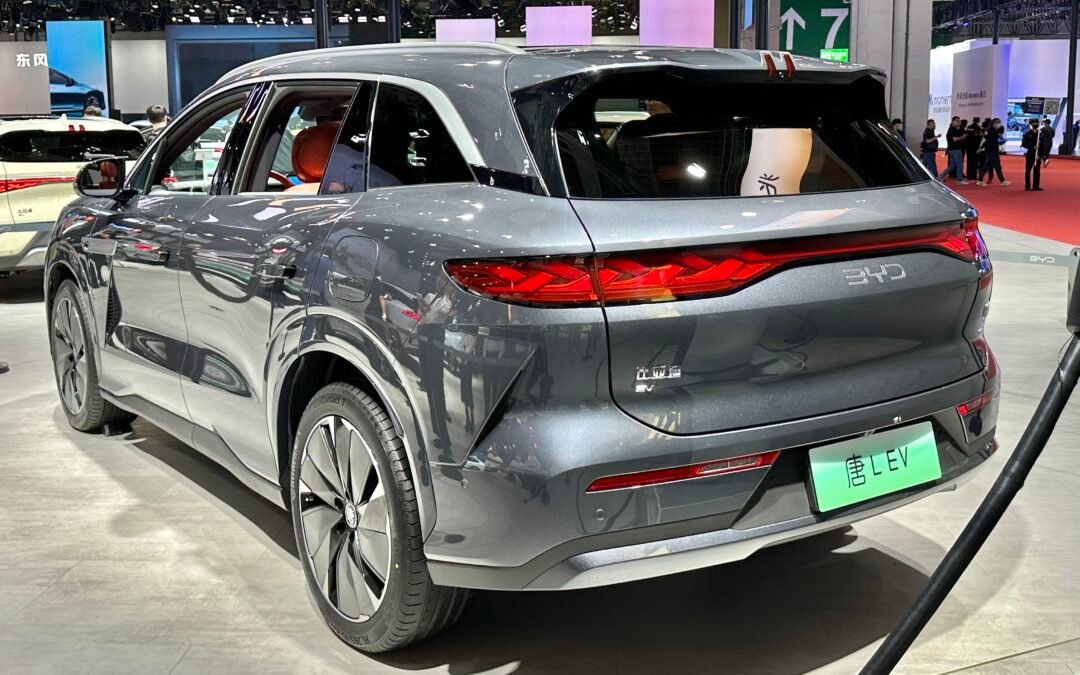
BYD has thrown another heavyweight punch in the global electric vehicle race, launching its new Great Tang seven-seat SUV in China with the kind of range, charging claims and pricing that make every rival pay attention. The headline numbers are hard to ignore: a starting price of 239,900 yuan, around US$35,500, and a flagship battery-electric version claiming up to 950km of CLTC range.
The launch, reported by Bloomberg and Electrek on June 17, puts BYD directly into the large family SUV conversation at a price point that undercuts many premium electric crossovers. For EV buyers, the Great Tang matters not just because it is big and relatively affordable, but because it shows how quickly Chinese brands are compressing the gap between mass-market pricing and luxury-grade specifications.
BYD’s large SUV strategy gets serious
The Great Tang, also referred to as the Datang, is a full-size, three-row SUV stretching roughly 17 feet long. Electrek reports that the entry Premium EV uses a 105.79kWh battery for a claimed 800km CLTC range, while the Flagship EV steps up to a 130.15kWh pack and a claimed 950km. BYD is also leaning on its fast-charging story, with reports pointing to recharge times as low as five minutes under ideal high-power conditions.
Those figures should be read with the usual real-world caution: CLTC range ratings are generally more optimistic than WLTP or EPA-style testing, and ultra-fast charging depends heavily on charger availability, battery temperature and state of charge. Even so, the direction is clear. BYD is making long-range electric SUVs feel less like exotic luxury products and more like attainable family transport, at least in its home market.
Tesla still shapes the conversation
Tesla remains the benchmark brand many EV shoppers compare against, but this week’s news cycle shows the pressure coming from several directions. Electrek reported that Tesla’s robotaxi footprint remains far smaller than its public ambition, with tracker data showing a limited number of active vehicles and only a small subset operating unsupervised. That does not erase Tesla’s software lead, but it does remind buyers that autonomy promises are still being tested in public, one cautious rollout at a time.
At the same time, Rivian chief executive RJ Scaringe told WIRED that advanced driver-assistance software may eventually become embedded in the vehicle price, much like airbags did after starting life as optional equipment. That is a pointed comment in a market where Tesla has moved Full Self-Driving toward a subscription model. If autonomy becomes a standard feature rather than a premium add-on, the business model for EV software could shift dramatically.
Competition is turning into better value
For Australian EV watchers, BYD’s momentum is particularly relevant. The brand has been expanding rapidly in Australia with models such as the Atto 3, Seal, Sealion 7 and Shark plug-in hybrid ute, while recent reports from The Driven have highlighted BYD’s growing supply chain confidence, including purpose-built car carriers delivering thousands of vehicles to meet demand. Whether the Great Tang itself lands locally remains to be seen, but BYD’s product cadence suggests more large electrified family vehicles are likely.
The broader takeaway is that the EV market is maturing fast. Range is improving, charging speeds are becoming a selling point, and software features are moving from novelty to expectation. Tesla may still command attention, but BYD is proving that scale, batteries and aggressive pricing can be just as disruptive. For EV enthusiasts, the next wave of electric SUVs should bring more choice, sharper prices and a much tougher fight for every driveway.