
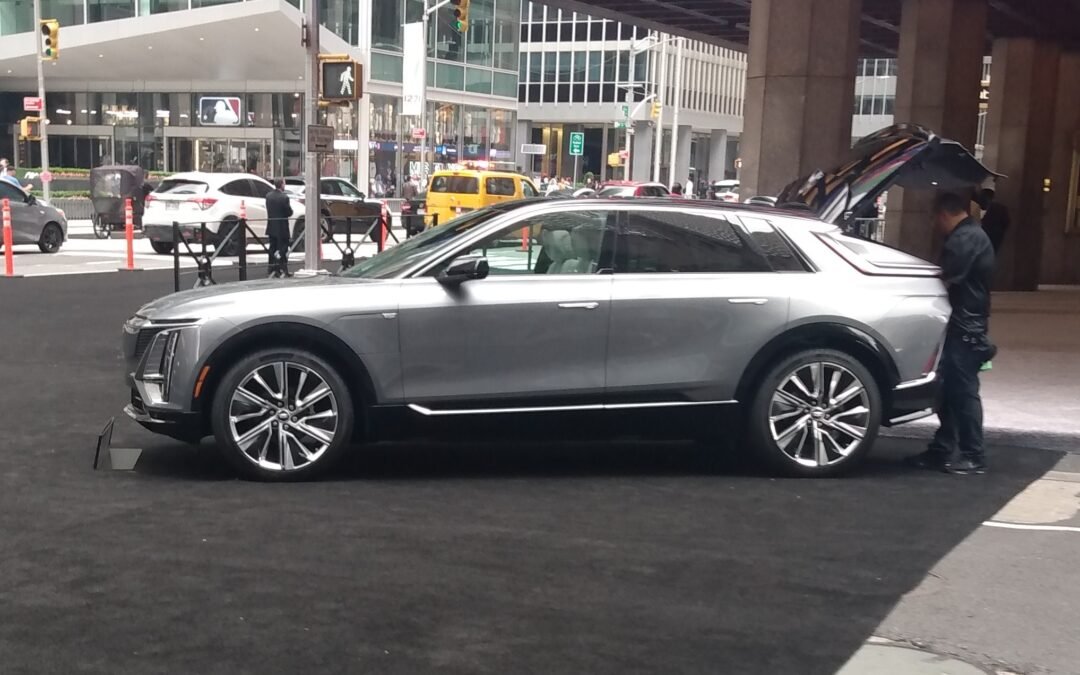
Cadillac’s Lyriq is getting a small piece of hardware that says a lot about where the electric-car market is headed. For the 2027 model year, the luxury EV crossover is expected to add a native North American Charging Standard port — the Tesla-style connector that has quickly become the plug of choice across much of the U.S. market. It is not a wild redesign, and it is not a headline-grabbing horsepower war. But for everyday EV shoppers, it may matter more than either.
Cadillac joins the native NACS shift
According to Electrek, the 2027 Cadillac Lyriq will see only a modest $200 price increase while adding the native NACS port. That puts it in step with other General Motors electric models, including the Cadillac Optiq, Vistiq and Escalade IQ, plus Chevrolet’s Blazer EV, Equinox EV and next Bolt. The practical advantage is simple: fewer adapters, easier access to Tesla Superchargers where compatible, and a charging experience that feels less like an engineering workaround.
The move also shows how quickly the industry has converged on charging convenience as a selling point. Early EV marketing leaned heavily on range figures and 0-60 mph times. Those numbers still matter, but buyers increasingly want to know whether a car can road-trip without drama. A native NACS port does not automatically fix every charging issue, but it removes one layer of friction at a time when shoppers are comparing electric models against gasoline vehicles, hybrids and plug-in hybrids that require less planning.
Fast chargers are still being built
The timing is notable because America’s public charging network keeps expanding even as EV demand has become more uneven. InsideEVs, citing data from EV charging analytics firm Paren, reported that more than 3,000 new DC fast-charging plugs were installed in the U.S. during the first quarter of 2026. That buildout continued despite a reported 27% year-over-year drop in EV sales for the quarter, suggesting charging companies are still thinking in years rather than reacting to one soft sales period.
That infrastructure momentum is crucial for brands like Cadillac. Premium EV buyers expect the car, the route planner and the charger to work together with minimal fuss. If GM can pair native NACS hardware with better software, reliable station data and competitive charging curves, the Lyriq becomes easier to recommend to buyers who like the EV idea but have been waiting for the ecosystem to mature.
The wider EV market is getting more complicated
Globally, EV growth is still moving forward, just not in a straight line. EV Volumes’ latest outlook says global plug-in sales reached 21.6 million vehicles in 2025 and are forecast at 22.7 million in 2026, with market share rising to 24.7% as incentives decline and competition tightens. In other words, electrification is not disappearing — it is entering a tougher, more price-sensitive phase where convenience, charging access and product discipline matter more.
Not every manufacturer is following a clean electric path. Audi made waves this week with the reveal of the Nuvolari, a 1,001-hp hybrid supercar built around a V8, despite earlier messaging that new Audi launches from 2026 onward would be electric. That contrast captures the current EV moment: mass-market and luxury crossovers are racing toward standardized charging, while performance brands still see room for combustion-assisted halo cars.
For EV enthusiasts, the takeaway is encouraging but realistic. The next big leap may not be a moonshot battery or a 700-mile range claim. It may be the boring-but-important stuff: standardized plugs, more fast chargers, clearer pricing and cars that make electric ownership feel normal. Cadillac’s Lyriq update fits that trend perfectly — a small connector change that could make a big difference at the plug.
Sources: Electrek on the 2027 Cadillac Lyriq NACS update; InsideEVs on U.S. fast-charger growth; EV Volumes market forecast; Electrek on Audi’s Nuvolari hybrid reveal.