
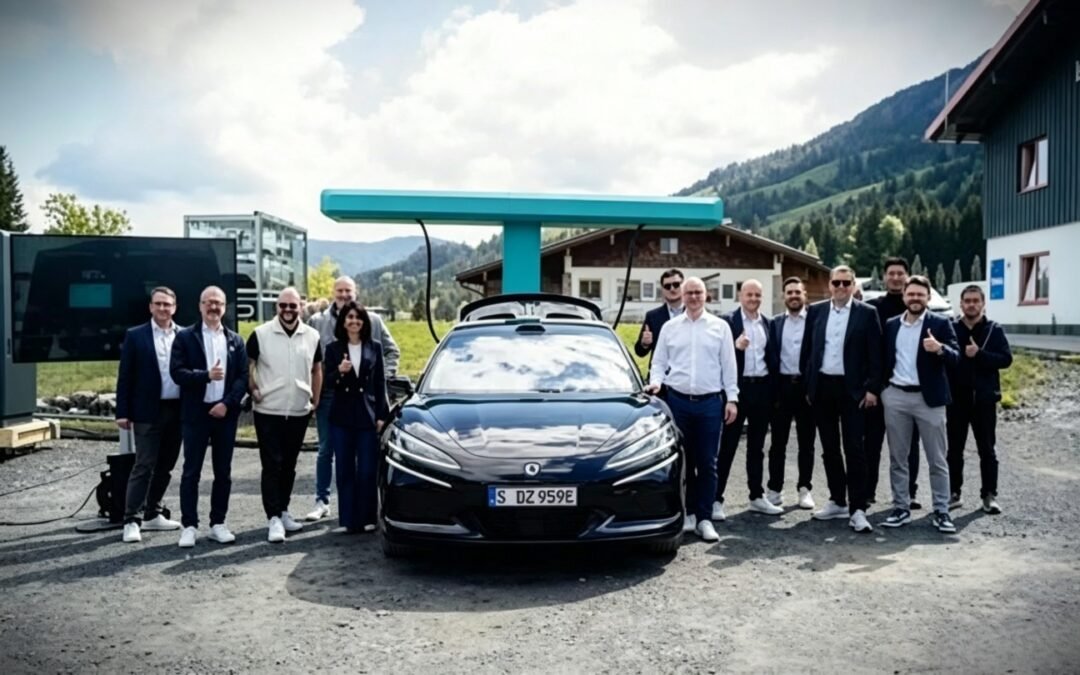
BYD has turned one of the biggest electric-car talking points into a real-world rollout: charging that can be nearly as quick as a coffee stop. The Chinese EV giant has opened its first commercial flash-charging station in Germany and, according to fresh reporting from Electrek, has also switched on its first UK unit, pushing its 1,500 kW technology into Tesla Supercharger territory and beyond.
BYD brings megawatt charging to Europe
The headline number is hard to ignore. BYD’s latest Flash Charging hardware is rated at up to 1,500 kW, around three times the 500 kW peak associated with Tesla’s latest V4 Supercharger equipment. CarNewsChina reports the German station is part of a plan for 3,000 ultra-fast charging sites across Europe by the end of 2026, with compatible BYD technology claimed to charge from 10% to 70% in about five minutes and from 10% to 97% in nine minutes.
That does not mean every EV will suddenly gain five-minute refuelling stops. The car, battery chemistry, connector, cooling system and charging curve all have to support those power levels. But the direction is clear: BYD is no longer just exporting cars. It is beginning to export the infrastructure ecosystem around them, using the rollout to support Denza and other higher-end models as it tries to build credibility in Europe beyond low prices.
Tesla still frames the charging conversation
Tesla remains the benchmark because its Supercharger network is proven, widespread and increasingly open to rival brands. That makes BYD’s move especially interesting. If BYD can offer faster peak charging and competitive pricing while building enough reliable sites, it could challenge one of Tesla’s strongest ownership advantages. Electrek reported BYD’s UK team is targeting pricing around 50 pence per kWh, a figure that would make the network attractive if it holds up at scale.
The broader EV industry is also converging on easier charging. InsideEVs reports General Motors is integrating Tesla Supercharger, Ionna and Electrify America access into its brand apps through a new Energy Pass system, with EVgo and ChargePoint planned next. GM also says all 2027 EVs from Chevrolet, GMC and Cadillac will move to native NACS ports, another sign that charging convenience is becoming as important as range in the next phase of EV competition.
Cheap EVs and long-life batteries broaden the story
There was more news at the affordable end of the market, too. Mexico’s government-backed Olinia Uno was revealed as a locally designed six-seat EV expected to cost about $8,600, with a modest 77-mile range and a 31 mph top speed. It is closer to a neighbourhood EV than a highway cruiser, but it highlights a theme global automakers cannot ignore: many buyers need practical, low-cost electric mobility more than huge batteries and luxury screens.
Meanwhile, fresh analysis from InsideEVs of an iSeeCars longevity study offered a useful counterpoint to old doubts about EV durability. Tesla ranked in the top fifth of brands most likely to reach 250,000 miles, with a 4.6% chance, just under the industry average of 4.8% and tied with GMC. For an EV-only brand, that is a meaningful data point for shoppers worried that battery-powered cars will not go the distance.
For EV enthusiasts, the takeaway is simple: the race is shifting from who can build an electric car to who can build the best complete ownership experience. BYD is betting on extreme charging speeds, Tesla still has the network gravity, and legacy brands are scrambling to make plugging in feel invisible. The winners will be the drivers who spend less time waiting and more time moving.
Sources: Electrek, CarNewsChina, InsideEVs on GM charging, InsideEVs on Olinia, InsideEVs on Tesla longevity.