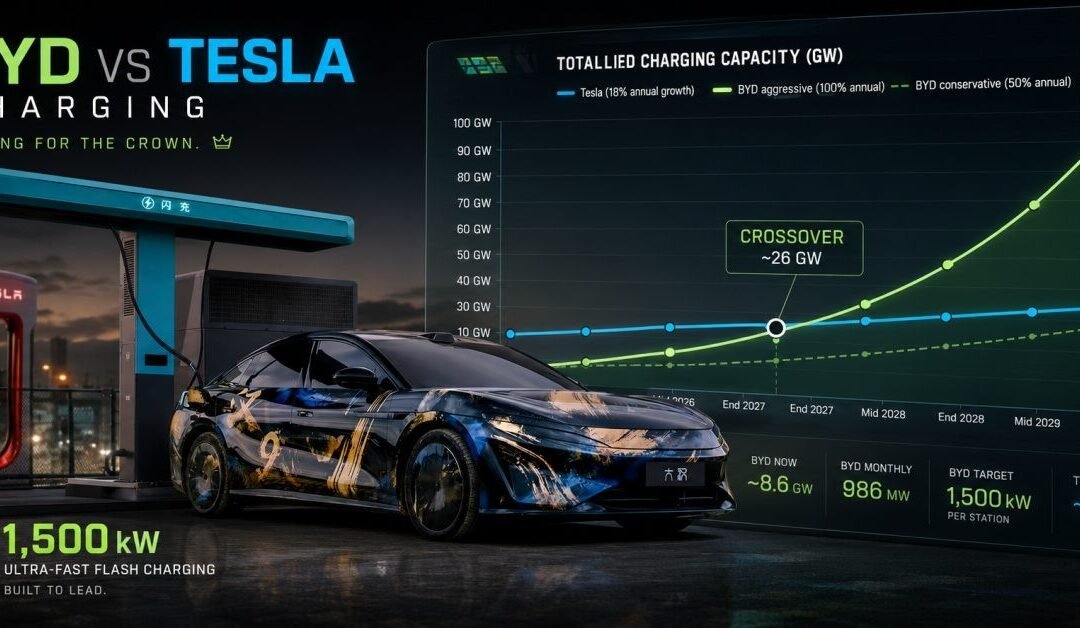
BYD has picked a fight with one of Tesla’s greatest advantages: charging. The Chinese EV giant is rapidly rolling out its high-powered Flash Charging network, a system capable of delivering up to 1,500kW to compatible vehicles, and it is doing so at a pace that makes the Supercharger network look newly vulnerable.
BYD’s charging push gets serious
According to Electrek, BYD has already deployed more than 5,700 Flash Charging stations in China in only a few months, with early overseas sites now appearing in Europe. The headline number is eye-catching: 1,500kW is three times the peak rating of Tesla’s latest V4 Supercharger hardware, and far beyond what most current EVs can accept. On BYD vehicles using its newer Blade Battery 2.0 and 1000-volt architecture, the company claims a 10 to 70 percent charge can take about five minutes, with 10 to 97 percent possible in roughly nine minutes.
That does not mean every EV buyer will suddenly charge at megawatt speeds tomorrow. Charging rates depend on the car, battery chemistry, temperature, state of charge and the power available at the site. Tesla’s Supercharger network also remains one of the most reliable and widely recognised fast-charging systems in the world, and for many drivers that consistency matters more than a single peak-power figure. But BYD’s move is important because it attacks the anxiety that still stops some buyers from going electric: the fear that charging will be slow, inconvenient or unreliable.
Tesla still has scale, but BYD has momentum
The broader contest between Tesla and BYD is now about more than cars. Tesla reclaimed the global battery-electric sales lead in the first quarter of 2026, with InsideEVs reporting 358,023 deliveries versus BYD’s 310,389 pure EVs. Yet BYD remains a massive force when plug-in hybrids are included, and its lineup is far broader across small cars, SUVs, sedans and commercial vehicles. Electrek also reported that BYD sold more than 4.6 million new-energy vehicles last year, overtaking Ford globally, while chief executive Wang Chuanfu told shareholders the company aims to become the world’s largest automaker by scale within five years.
Australia shows why the competition matters. The Driven’s latest market reporting says EVs reached a record 20 percent share of new-vehicle sales in May, helped by strong performances from Tesla, BYD, Jaecoo and Geely. BYD has also been building local momentum with large shipments and an expanding range, while Tesla’s Model Y and Model 3 remain benchmark choices for many buyers. For Australian shoppers, the result is a healthier market: more models, sharper pricing and faster pressure on public charging providers to improve.
Prices and politics are shaping the next phase
In the United States, Kelley Blue Book data cited by Electrek shows new EV sales topped 85,000 in May, the strongest month since federal tax credits ended, while average EV transaction prices fell to $54,532. Tesla’s pricing continues to pull the market down because it still represents such a large share of American EV sales, especially through the Model 3 and Model Y. At the same time, BYD is facing political headwinds after being added to a Pentagon list of Chinese military-linked companies, a designation the automaker says it is prepared to fight legally.
The takeaway for EV enthusiasts is simple: the next big leap may happen at the charger as much as in the showroom. If BYD can bring ultra-fast, dependable charging to more markets while Tesla keeps expanding and opening its network, buyers win. Faster charging, lower prices and tougher competition are exactly what the EV transition needs next.